For the past five years, I have participated in the annual Extra Life fundraiser for Children’s Miracle Network Hospitals®. For those non-Extra Lifer’s out there, it is a 24-hour fundraising and gaming marathon to support Children’s Miracle Network Hospitals. I could start this post out by going through all the reasons why Children’s Miracle Network Hospitals are awesome, however, for the first time ever I’m going to talk about WHY I chose to spend my time, money and energy raising for local Children’s Miracle Network Hospitals.
Starting with Why
Recently, when reflecting on my Extra Life experience over the past five years I had a major epiphany…it has been mediocre at best. That is not to say I have not enjoyed the experience, as I have enjoyed it tremendously however, I am sitting here realizing that I have not fully lived up to my expectations. To date I have personally raised $750 for local Children’s Miracle Network Hospitals in Kansas, Missouri and now Tennessee. While, every dollar is important, I have had this unshakeable thought that I can do FAR better.
This thought has seen me reflecting on why I have not lived up to my expectations. That was until I stumbled upon some old work materials from when I used to present community engagement and development presentations to students. The materials in question were related to a concept presented by Simon Sinek a fabulous author and speaker whom I have drawn inspiration from over the years. Within the materials I laid out Simon’s simplest concept, that is I presented to them the idea of the Golden Circle. Now, I could write an entire post on Simon’s concept however, the principle of the Golden Circle is simple; all successful companies, leaders and people start not with the what they do or how they do it but are instead driven by a cause also known as the WHY. Simply put I was trying to sell supporters on what I was doing and not why I was doing it.
Why Play?
Now I could save the reason why I fundraise by playing games for Extra Life and Children’s Miracle Network Hospitals for the very end but for those with a modern day attention span or whom just for some reason have a burning desire to know right this instance, it’s simple…I play because play is important. Now at this point I have either confounded you with a seemingly broad statement or I have satisfied your initial desire. Let me take some time to explain. As I rewind all my life experiences to date, no experience best illustrates the importance of play than my time spent as a student at Baker University in Baldwin City, KS.
As a student at Baker, I was involved in a great many activities both on campus and off. However, this story revolves around one single activity of mine while in college. Starting around my Junior year of college I began volunteering once a week at a rural elementary school in the area. For background, the school in question was relatively small, with six grades and only one teacher per grade level.
At this school there was one student that seemed to light up when I arrived on campus. For the sake of this writing we will refer to the student as Taylor and use they, them, and their pronouns for privacy purposes. Now at first, I did not attribute anything to this sudden burst of happiness in Taylor as I just assumed, they were excited to see someone new. After all, even the teachers were always glad to see me, because as a Physical Education major I had a set of skills and knowledge that did not fully possess themselves. Unlike larger schools in the surrounding area they lacked what I would call extracurricular teachers covering subjects such as Physical Education, Music and Art. This meant that often the individual teachers were called upon to be certified in subjects that they were not always fully prepared to teach.
This meant that rather than building bulletin boards or helping teach fractions, I often found myself leading physical education activities for the teachers. This is where Taylor comes into play; you see Taylor unlike their classmates was bound to a wheelchair and struggled with upper body mobility. For me this wasn’t a big deal, after all as a P.E. major I was required to take classes on adapted physical education and my professors always drove home the idea and importance of inclusion. So every week before going to the school I would develop a set of activities modified in such a way that Taylor could participate. This I would later learn is exactly why Taylor was always so excited for me to come to the school.
During a random visit to the school to pick up an item I had forgot on my last visit, I walked past the gym on my way inside the school. There I saw and heard the elated giggles and happiness of children who for at least a moment were free of the monotony of a “traditional” classroom. That was of course until I noticed that Taylor was not one of the children playing but instead was sitting off in a corner of the gym largely by themself. Now as a side note before you start screaming about the teachers and their responsibility in this situation it is important to remember that all the teachers enjoyed Taylor and worked very hard in the classroom to include them, however, in a Physical Education setting they lacked some of the same skills I had more importantly they also lacked YouTube because this was the stone ages before Google became our all seeing overlord. Seeing this I stopped in to say hi to the teacher and see if they needed assistance, upon which Taylor saw me and instantly lit up. It was at this moment I realized why they loved when I came to school. It had nothing to do with me but instead what I represented, for Taylor I represented a chance to play..
Importance of Play
I later in the week discussed this situation with one of my professors, who used the situation as an educational tool as she often did. She talked a lot about how play teaches us a lot of things that traditional education sometimes does not. Specifically, play helps us develop things like our emotional intelligence, promotes resilience, fosters natural creativity, and helps us develop and improve relationships and our connection to those around us. In other words, play is critical to people and a lack of both free and structured play can inhibit our development, lead to increased stress and potential mental health concerns.
“Play is often talked about as if it were a relief from serious learning. But for children, play is serious learning. Play is really the work of childhood.”
— FRED ROGERS
This led me to reflect on how Taylor must have felt at school most days. For Taylor, play was not simply something that happened suddenly and spontaneously. Instead it had to be planned and conscious effort had to exerted by all participants to meaningfully include them. I cannot help but think the emotional toll this could have on someone let alone the loneliness that Taylor likely felt because of it. Think about it for a second, how different would your life had been as a child if you did not have the opportunity to play freely or regularly. Play is so critical to human development that we often take it for granted and forget how privileged many of us were to have truly experienced it growing up.
Pressing Play
In retrospect it is no surprise that I majored in Physical Education and then went into a career where I regularly planned large events. It is the same reason that favorite hobbies are playing video games, making puppets, and going to theme parks, because play is EVERYTHING to me. According to Hyrum Smith the founder of Franklin Covey, Play would be one of my governing or cardinal values. Which would make sense as playing has long been not only my way of relieving stress but also for connecting with others and identifying my role or place within a community. It is precisely for this reason that I started participating in Extra Life back in 2016.
Looking back at my Taylor story, it was my love of play and my belief that play makes the world a better, caring and more inclusive place that brought me to Extra Life and Children’s Miracle Network Hospitals
Why Extra Life

I first learned about Extra Life back in 2015 and it should not be a surprise that I learned about it playing a video game (shocking revelation I know). It feels like chance that I stumbled upon it during my numerous exploits in my 2015 game of choice: Star Wars the Old Republic (SWTOR for short). After reflecting on my past, however, it now feels like fate. After all it combined my love of play and video games with a deep desire to improve the lives of others. However, it was not that love and desire that ultimately drove me to participate. Instead it was Extra Life’s story of how it came about that resonated so deeply for me.
While, I could never bring justice to the story told in the video it reminded me a lot of Taylor’s story and the importance play and how much of an impact being confined to a hospital can have on a child’s life. The parallels between my past with Taylor and Extra Life’s story of Victoria are what ultimately led me to take up arms or in this case a controller.
Why Children’s Miracle Network
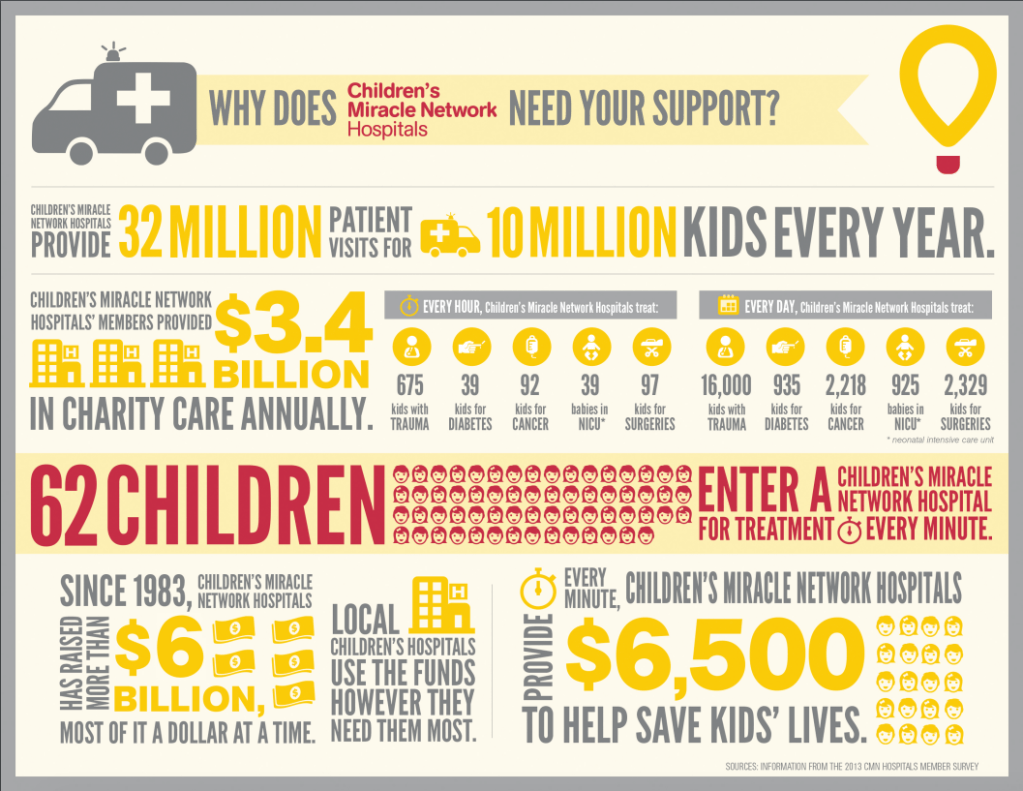
I could continue to drive home the concept of play and how Children’s Miracle Network helps sick and injured kids get back to being themselves, however, my why with Children’s Miracle Network is simple. As a professional there is one thing that I have obsessed over in the past several years and that is ensuring that organizations and people within them are values driven. In this case my love of Children’s Miracle Network is their adherence to their founding principles and values.
100% of proceeds would stay local to benefit local hospitals and kids
First and foremost, all money raised go to local hospitals to benefit local communities. In a day and age where it is not uncommon to hear about multibillion dollar “charities” paying CEO’s and marketing firms exorbitant amounts of money with little going to the advancing the mission of the organization. At Children’s Miracle Network no money that is donated by individuals goes to paying the salary of governing executives. Instead the headquarters in Salt Lake City raises money for the central office through corporate sponsorships. Basically, when someone donates to Children’s Miracle Network it goes directly to a hospital of their choosing.
Kids first and always and Maintain the lowest cost ratio possible
I remember at my previous job at Missouri University of Science and Technology we always talked about being good stewards of student’s money. This meant being transparent with expenses, not wasting money and ensuring that every expenditure went to improving the student experience. Children’s Miracle Networks principle to put kids first and be good stewards of their donor’s money strikes a resoundingly similar tone with me. Because Children’s Miracle Network Hospitals are funded by donations it is critical, they keep costs low while providing exceptional care. In many cases the networks hospitals provide care to sick and injured kids at no cost to the families as they understand that having a sick child is enough of a burden.
Dignity and Class. Never Exploiting sick or injured kids
As someone who believes that all people have an inherent self-worth, I support Children’s Miracle Network because of their care and compassion for patients and their families
It’s Not Game Over
Unlike this post, which is quickly approaching the end, no child should ever have their ability to play and ultimately their life be negatively impacted by sickness, disabilities, or injuries. My why started with Taylor and while it took me nearly a decade to realize it I now use that why to press forward into the future as I know there are other children out there just like Taylor who desperately want to play. It is for this very reason why I will continue to press play on the first Saturday of November each year. Thank you for your time and support and remember that it is never goodbye or in this case game over, it is just until next time. Until then keep pressing play.

 Musings of a Gamer
Leave a comment